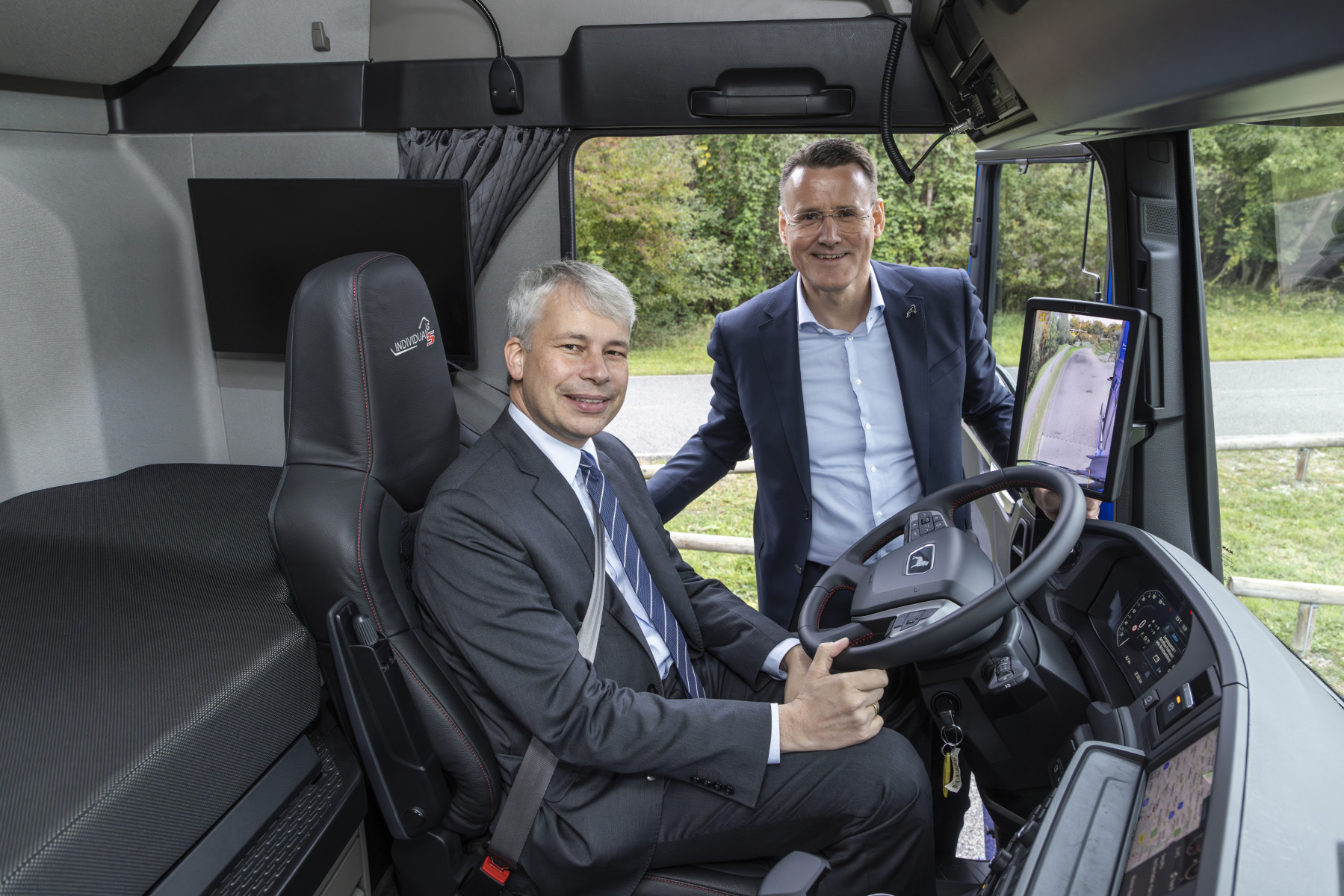
German Federal Minister of Transport tests MAN electric truck suitable for long-haul transport
Faster progress needed on framework conditions
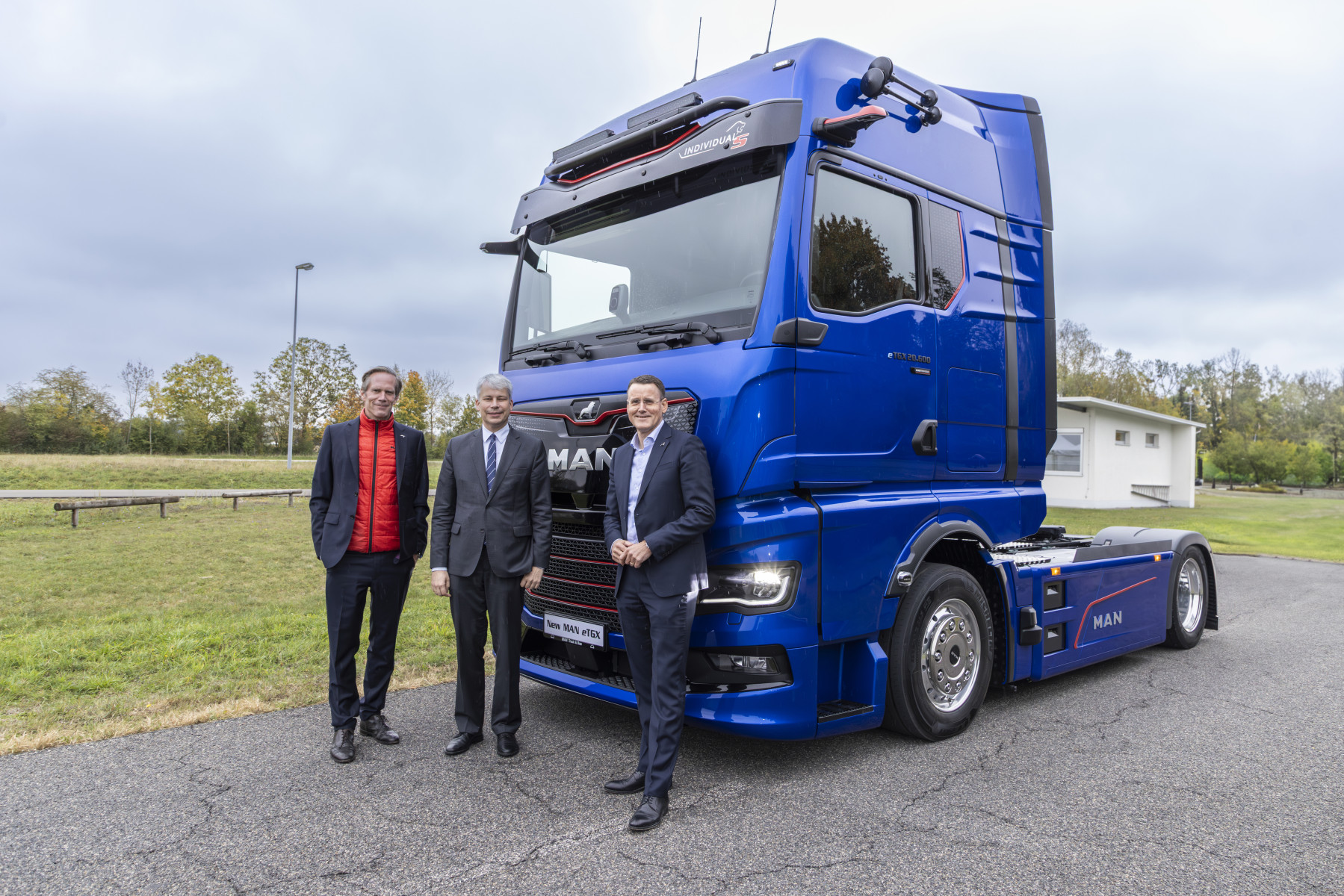
- German Federal Minister of Transport Steffen Bilger learns about the latest electric truck technology at MAN and tests the MAN eTGX
- Electric trucks are suitable for everyday use and proven in real-world operation – charging infrastructure, electricity grids, financing and industrial policy framework conditions must now keep pace
- New MAN eTGX travels up to 720 kilometres without intermediate charging and is therefore fully suitable for long-haul transport – it charges via the Megawatt Charging System at up to 750 kW in around 30 minutes
- MAN electric trucks have already covered more than 60 million kilometres in customer operations
MAN has been producing electric trucks in series for more than a year now, making them ready for a broad market ramp-up. To achieve this, the framework conditions for electromobility must keep pace with the speed of industry and the transport sector. This message was at the heart of German Federal Minister of Transport Steffen Bilger’s visit to MAN Truck & Bus in Munich. During the visit, he learned about the technological innovations of the new MAN eTGX, which had celebrated its world premiere at IAA Transportation 2026 just a few weeks earlier. MAN electric trucks have already demonstrated that battery-electric drive is fully fit for everyday use, having covered more than 60 million kilometres in real customer operations since their market launch.
Following the product presentation and test drive, Bilger spoke with Alexander Vlaskamp, Chairman of the Executive Board of MAN Truck & Bus, and Frederik Zohm, Executive Board Member for Research and Development, about the next steps required for a successful ramp-up of battery-electric trucks.
“My visit to MAN has once again convinced me of the future viability of electric trucks. Road freight transport is central to Germany as a business location. At the same time, it faces the major challenge of becoming more climate-friendly. Above all, this requires a high-performance charging infrastructure. That is why we are making targeted investments in the development of a nationwide fast-charging network for electric trucks. Our multi-billion-euro funding programme envisages around 4,200 charging points at 350 service areas. We are also supporting companies that want to equip their depots with charging points, as well as investors building publicly accessible charging infrastructure for heavy-duty commercial vehicles. In this way, we are creating planning certainty for the industry. It is clear to us: the market ramp-up for electric trucks will only succeed with high-performance charging options. We are making our contribution to this,” says German Federal Minister of Transport Steffen Bilger.
“The Federal Minister of Transport’s test drive in our MAN eTGX shows that the electric truck is no longer a vision of the future, but a proven product for every application – whether on construction sites, in distribution or long-haul transport. Industry has delivered. Now policymakers in Brussels and Berlin must actively support the market ramp-up through charging infrastructure, grids, financing and industrial policy framework conditions. We welcome the launch of the Germany-wide fast-charging network for trucks. What matters now is rapid implementation. At the same time, the industry needs practical framework conditions, including the permanent approval of a gross combination weight of 44 tonnes for locally emission-free vehicles – in line with combined transport. If policymakers, industry and the transport sector jointly create the necessary conditions, the ramp-up of locally emission-free commercial vehicles can progress significantly faster – benefiting the climate, the economy and Germany as an industrial location,” says Alexander Vlaskamp, CEO of MAN Truck & Bus.
Key areas for action to ramp up the market
For electric trucks to gain widespread acceptance, it is not enough for the necessary charging infrastructure to grow rapidly. Logistics centres and haulage companies in particular also need high-capacity electricity connections: 70 to 80 per cent of trucks are charged there. Grid expansion must therefore take greater account of the requirements of freight transport.
However, infrastructure alone is not enough. The switch to electric trucks requires substantial investment from transport companies, not only in new vehicles, but also in charging infrastructure at their depots. Financial barriers must therefore be reduced and suitable funding opportunities created, particularly for small and medium-sized companies.
Finally, it is essential that companies can plan reliably in the long term. The expansion of charging infrastructure in many European countries is progressing considerably more slowly than intended. Since road freight transport is often cross-border in nature, better alignment is required across Europe between political climate targets and the actual conditions needed to achieve them. From MAN’s perspective, the timelines for truck and bus CO₂ targets should therefore be adjusted in line with the development of the necessary infrastructure. At the same time, Europe needs framework conditions that enable investment and help safeguard innovation, industrial value creation and jobs in Europe.
MAN eTruck already in its second generation
The new MAN eTGX has a range of up to 720 kilometres without intermediate charging, charges via the Megawatt Charging System (MCS) at up to 750 kW and is up to three per cent more efficient than its predecessor. An optimised vehicle front also improves direct visibility of other road users in front of and alongside the vehicle.
MAN’s electric commercial vehicle portfolio includes the eTGL, eTGM, eTGS and eTGX ranges, covering applications from 12 to 50 tonnes gross weight. With its modular battery system, the MAN eTGX can be tailored to different operating profiles. A typical 4x2 tractor unit with six batteries and 552 kWh total capacity achieves a range of up to 660 kilometres. The 6x2 tractor unit, which will also be available in future with seven batteries and 644 kWh total capacity, can travel up to 720 kilometres without intermediate charging.
At unchanged weight, the new battery generation offers up to ten per cent more usable energy. At the same time, drive output rises to up to 440 kW, or 598 hp. Maximum recuperation output also increases from 400 kW in the previous generation to 480 kW in the new eTGX. This means that on particularly mountainous routes, such as the Brenner route, the additional energy consumption uphill can be almost fully offset by subsequent downhill sections. Overall, higher recuperation, combined with the aerodynamically optimised vehicle front extended 120 millimetres forwards, enables an efficiency improvement of up to three per cent compared with the previous generation. With the optional MCS charging connector, the batteries can be recharged in around 30 minutes. The charging process can therefore be integrated into the driver’s statutory 45-minute break.